Last Updated on 11 February 2026
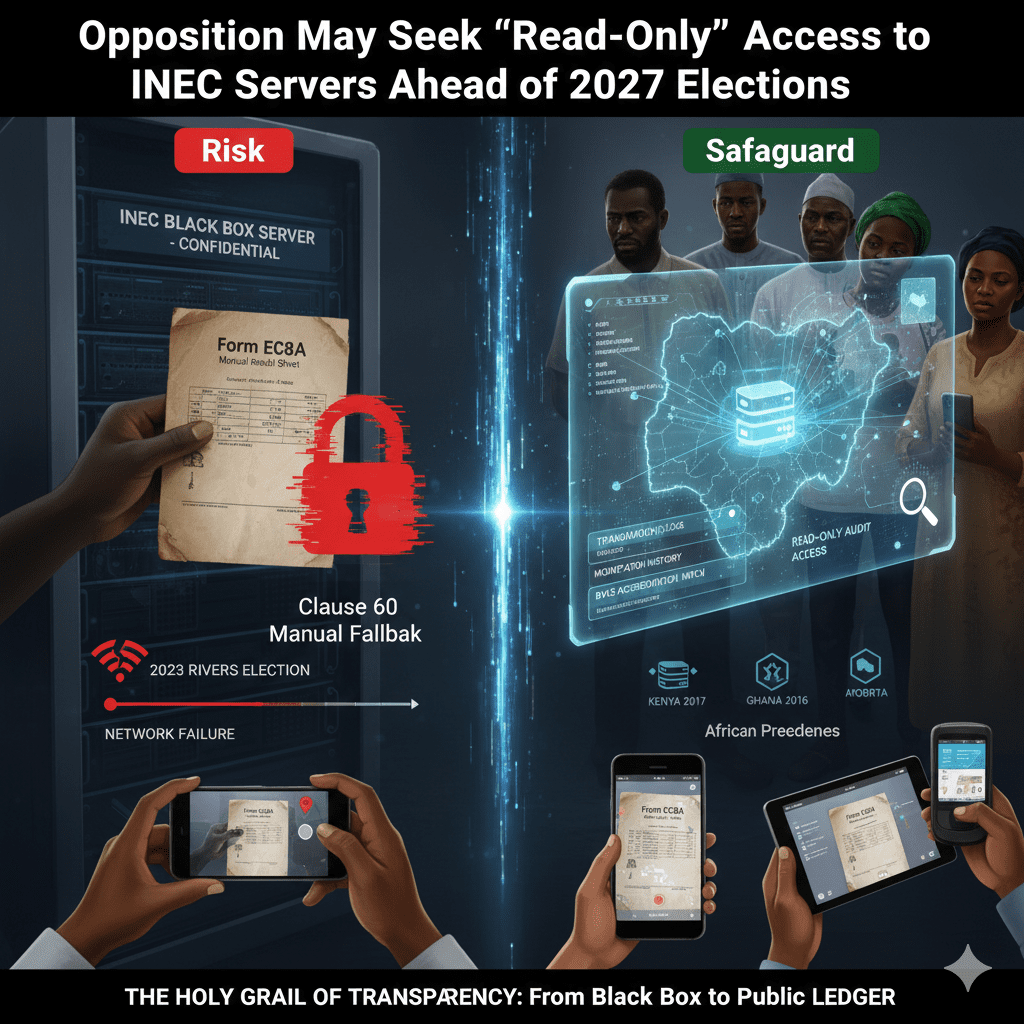
Ahead of Nigeria’s 2027 general elections, opposition parties and electoral reform advocates are pushing for unprecedented access to the Independent National Electoral Commission’s (INEC) servers, calling it the “Holy Grail” of transparency.
The proposal involves granting accredited political parties read-only, backend access to INEC’s systems, including the IReV portal and BVAS transmission logs. Supporters argue this would allow independent verification of results, making disputes over electronic transmission virtually impossible.
What “Read-Only Access” Means
Opposition parties would not be able to edit results but could monitor:
- Transmission Logs: The exact time results from each polling unit reach the central server.
- Modification History: Any updates to previously uploaded results, including who made the change and why.
- Accreditation Match: Verification that uploaded votes correspond with voters authenticated through BVAS in real-time.
Digital access, analysts say, would also expose attempts to misuse the “network failure” fallback. If a polling unit reports poor connectivity but other devices nearby transmit successfully, discrepancies would be instantly apparent.
Legal and Political Pathways
Currently, INEC treats its server infrastructure as confidential. Advocates argue that the 2026 Electoral Act provides a narrow window to push for audit access. Legal strategies under consideration include:
- Pre-Election Court Orders: Opposition parties could file for a judicial pre-emptive ruling allowing supervised server access, citing precedents in Kenya (2017 and 2022), where courts compelled the electoral commission to grant read-only access to petitioners.
- Digital Party Agents: Observers propose creating a new official category — IT Party Agents — stationed at INEC’s ICT headquarters to monitor incoming data streams in real-time.
- Public Transparency APIs: Civil society groups suggest tying server contracts to an API that enables authorised third parties to pull raw results as they arrive.
African Precedents: Lessons for Nigeria
Several African countries have implemented similar transparency measures that could guide Nigeria:
- Kenya (2017, 2022): The Supreme Court ordered supervised access to servers, allowing real-time verification of transmission logs.
- Ghana (2016): While the EC maintained a manual backup, it faced immense pressure to provide read-only access to the results collation system to reduce litigation.
- South Africa: Accredited parties observe the results management system directly, enhancing trust in the final tally.
Analysts say Kenya provides the clearest precedent, demonstrating that read-only or supervised server access can be legally enforced and operationally effective.
Risk vs Safeguard: The Clause 60 Paradox
The tension at the heart of the 2027 cycle lies in the contradiction between Clause 60’s manual fallback and the demand for server access.
While Clause 60 provides a “legalised escape route” for officials to abandon digital transparency under the guise of network failure, read-only server access serves as the ultimate digital forensic tool. It transforms the server from a “black box” controlled by the state into a public ledger. Without this access, the manual fallback remains an unpoliced backdoor; with it, any official claiming a “glitch” can be instantly cross-referenced against the actual performance of network logs.
Strengthening the Human Firewall
Even with backend access, party agents at polling units remain critical. Experts recommend an IT-enabled agent approach, including:
- GPS-Tagged Photos: Capture EC8A forms with location and timestamp metadata.
- Digital Affidavits: Record interactions with INEC officials in cases of glitches or manual overrides.
- BVAS Screen-Grabs: Photograph accreditation screens to document voter authentication.
These measures create contemporaneous evidence to cross-check paper forms and reduce opportunities for tampering.
“Opposition parties shouldn’t wait for the election to ask for access. Mock elections or system stress tests this year could reveal whether the infrastructure works as promised,” said an Abuja-based electoral analyst.
The Stakes
Civil society groups are calling on INEC to engage with political parties and establish clear procedures for monitoring digital results before the first ballot is cast in 2027. Analysts say this is the only way to restore public confidence and ensure the elections are credible.
Related posts:
 Massive Blackouts Rob 85M Nigerians of Power Access
  IPOB Counsel Advocates for May 30 Public Holiday in Honor of Biafra War Victims
  Nigerian Exchange Rebounds in May, Led by Chemical and Allied Products, Tantalizers, and Presc
  Six Key Takeaways from Tinubu’s (May 12) Democracy Day Speech 2024
  US, UK, Canada Warn Nationals in Nigeria Ahead of #EndBadGovernance Protests